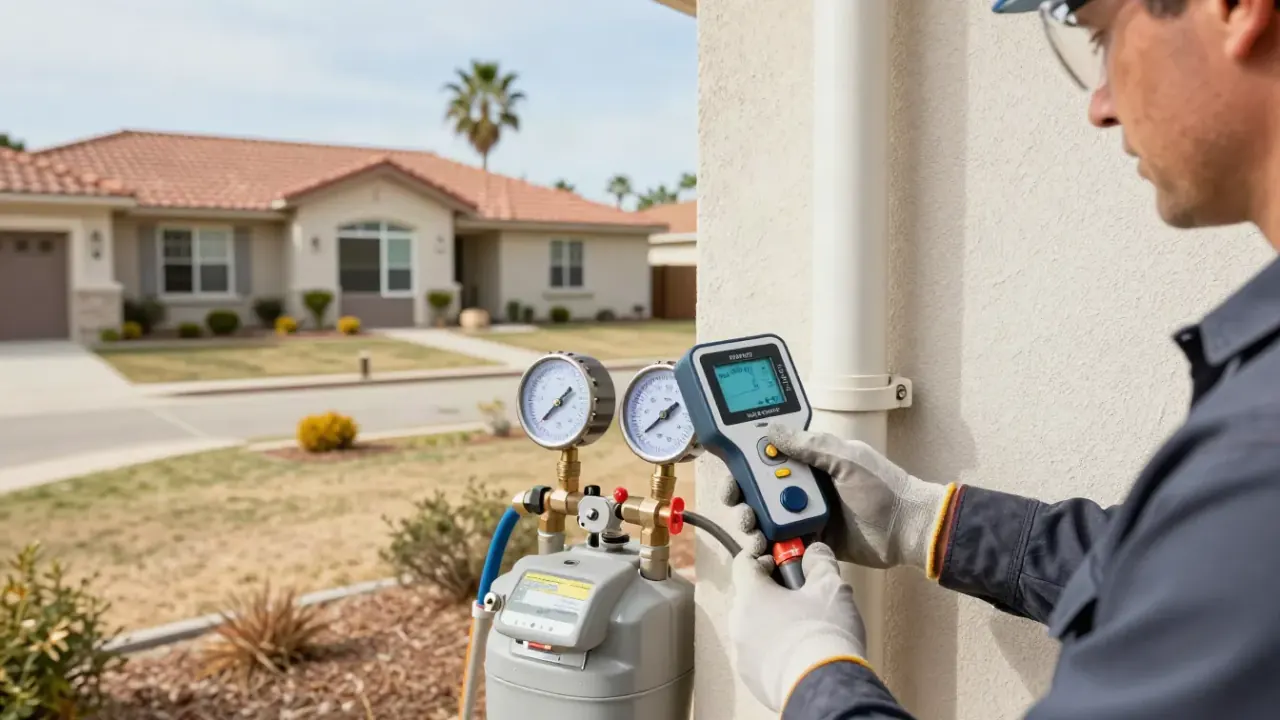
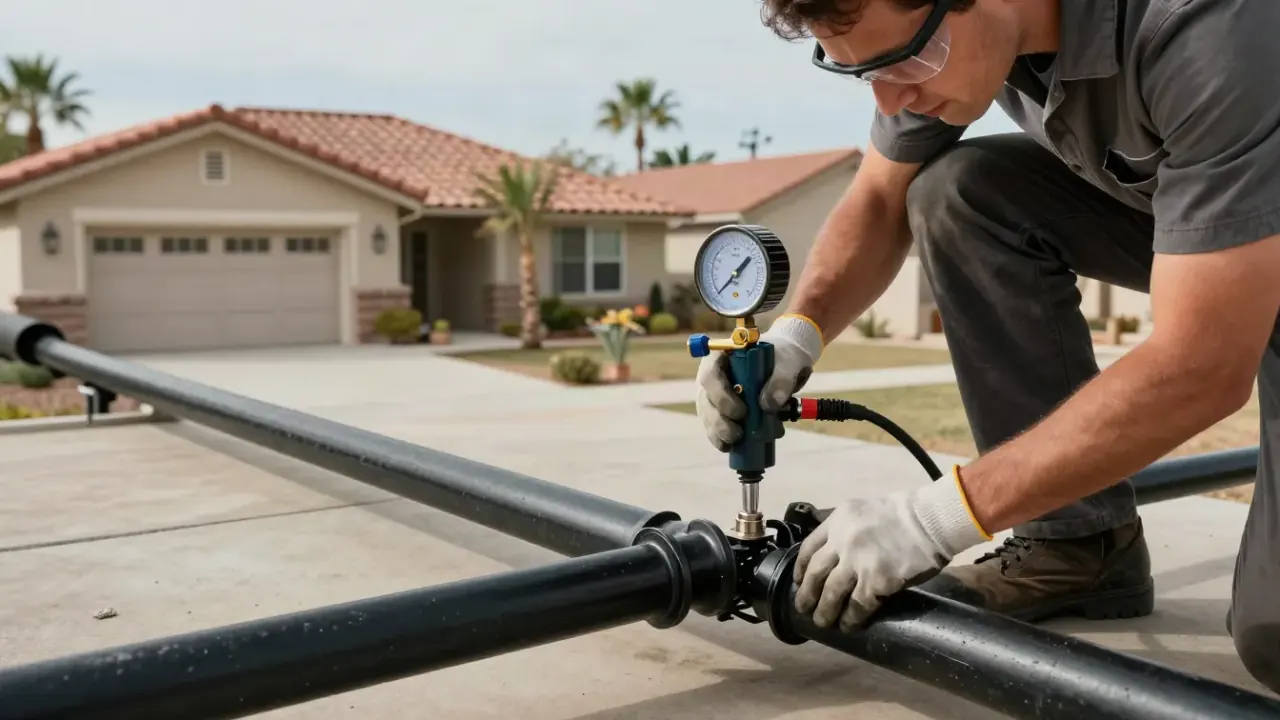
Gas Line Options for a Backyard Fire Pit
Natural gas or propane? Hard-piped or flexible? Here's how Fountain Valley homeowners choose the right fire pit gas line - with 2026 costs, permits, and timelines.
A backyard fire pit in Fountain Valley runs on one of two fuels: natural gas piped from your meter, or propane from a tank you refill. Natural gas is cheaper to operate and never runs out, but it requires trenching a line from your meter to the pit. Propane costs more per burn but installs in a day with no trenching. Gas line options for a backyard fire pit in Fountain Valley CA come down to that trade-off, plus how far the pit sits from your meter and whether you want the fire on a wall switch or a phone app.
Below we walk through fuel choice, routing, 2026 pricing, permits, and the mistakes that turn a weekend project into a callback. We install and repair these lines across Fountain Valley every week, so the numbers here are what we actually see on invoices.
Natural Gas vs Propane for a Fountain Valley Fire Pit
Natural gas wins on operating cost for almost every Fountain Valley homeowner who already has a meter at the house. At 2026 residential rates in Orange County, running a 60,000 BTU fire pit for three hours costs roughly $1.20 to $1.80 on natural gas. The same burn on propane runs $4 to $6 depending on tank refill pricing. Over a year of weekend fires, that gap pays back a good chunk of the installation.
Propane makes sense in three situations: your meter sits on the far side of the house from the yard, your HOA or lot layout makes trenching impractical, or you want the pit portable. A 20-pound tank feeds a small pit for about 4 to 6 hours. A 100-pound tank stretches that to roughly 20 hours, which is why most propane fire pits we see in Fountain Valley use a buried 120-gallon tank or a pair of 100-pound cylinders on a pad.
One more factor: heat output. Both fuels deliver the same BTU per hour at the burner. The difference is logistics, not flame quality. If you already pay for Gas Line Repair Fountain Valley CA service on your home's gas system, adding a fire pit branch is a small extension of work we already do.
How to Run a Gas Line to a Fire Pit in Fountain Valley, California
Running a gas line to a fire pit in Fountain Valley means trenching from the meter or an existing branch line out to the pit location, then connecting a buried line to a riser, valve, and burner. The trench must be at least 12 inches deep for schedule 40 black steel or 18 inches for polyethylene yellow pipe, per the California Plumbing Code. Most yards here need 25 to 60 feet of run.
Here is the sequence our crews follow:
- Locate the meter and any existing outdoor branch (pool heater, BBQ, dryer vent line).
- Call 811 for utility marking - free, and required before any digging.
- Trench the run, keeping 12 inches of horizontal separation from electrical conduit.
- Install the pipe, risers, and a shut-off valve at the pit.
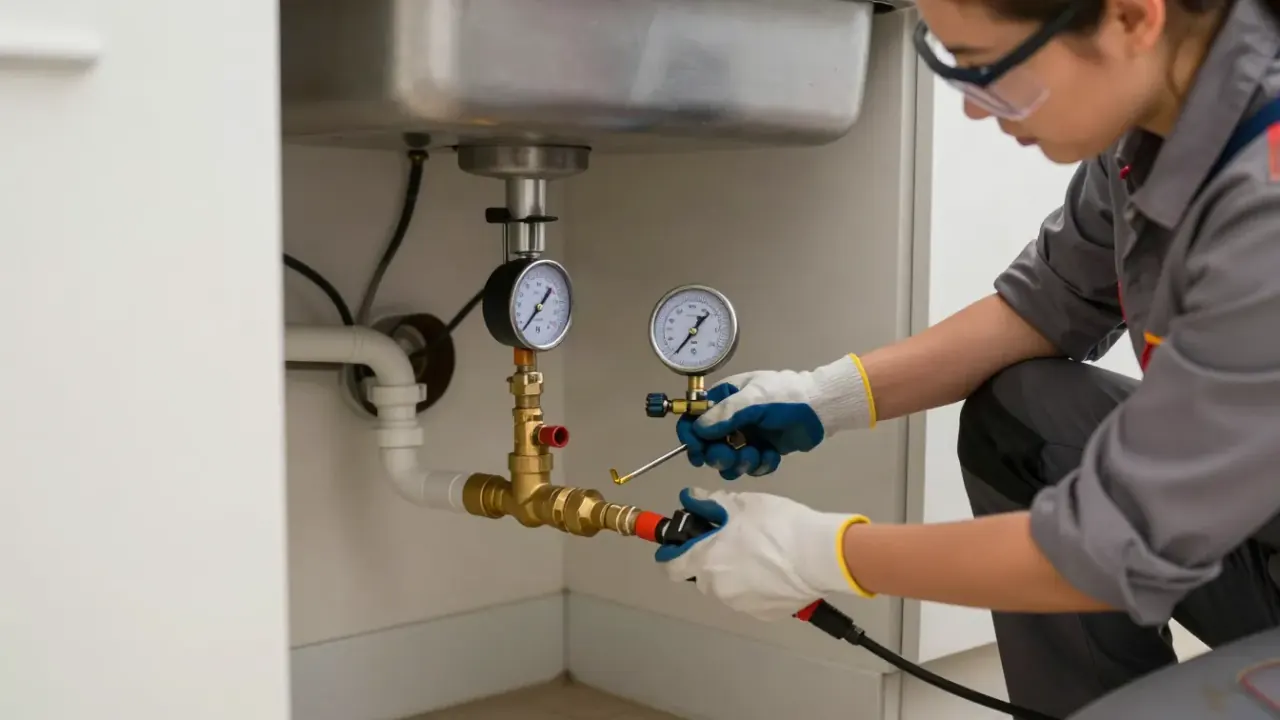
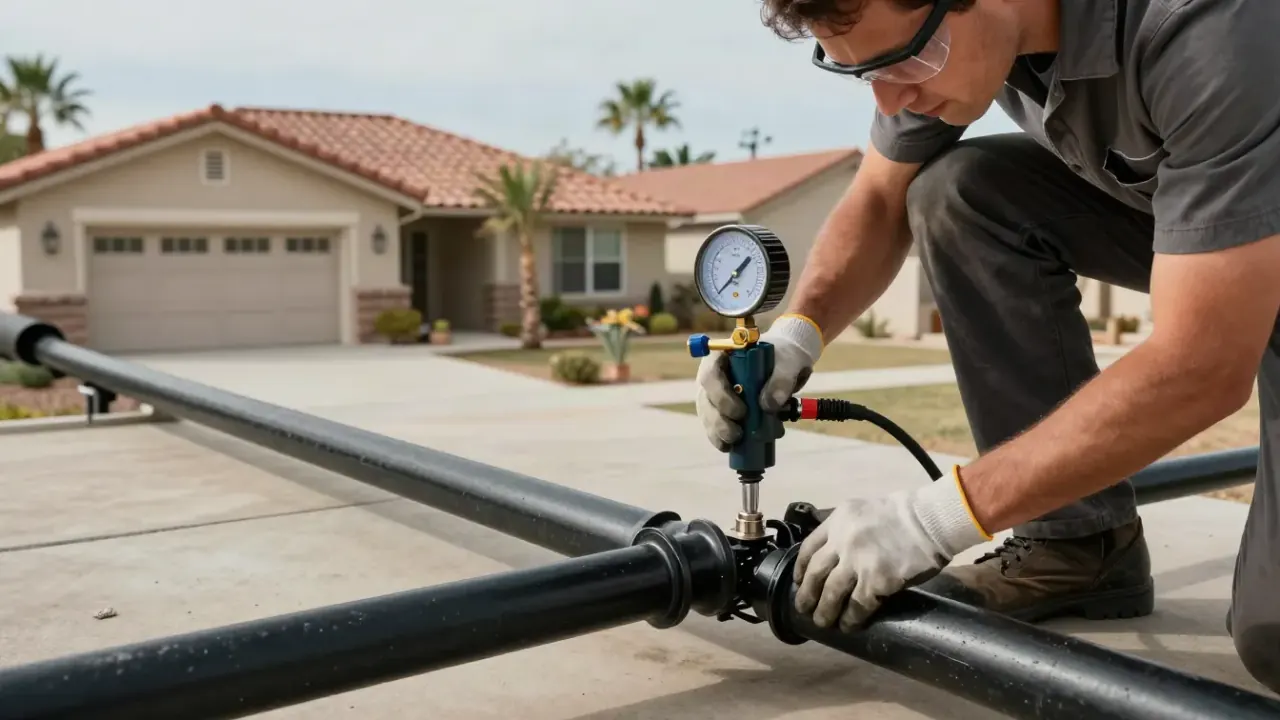
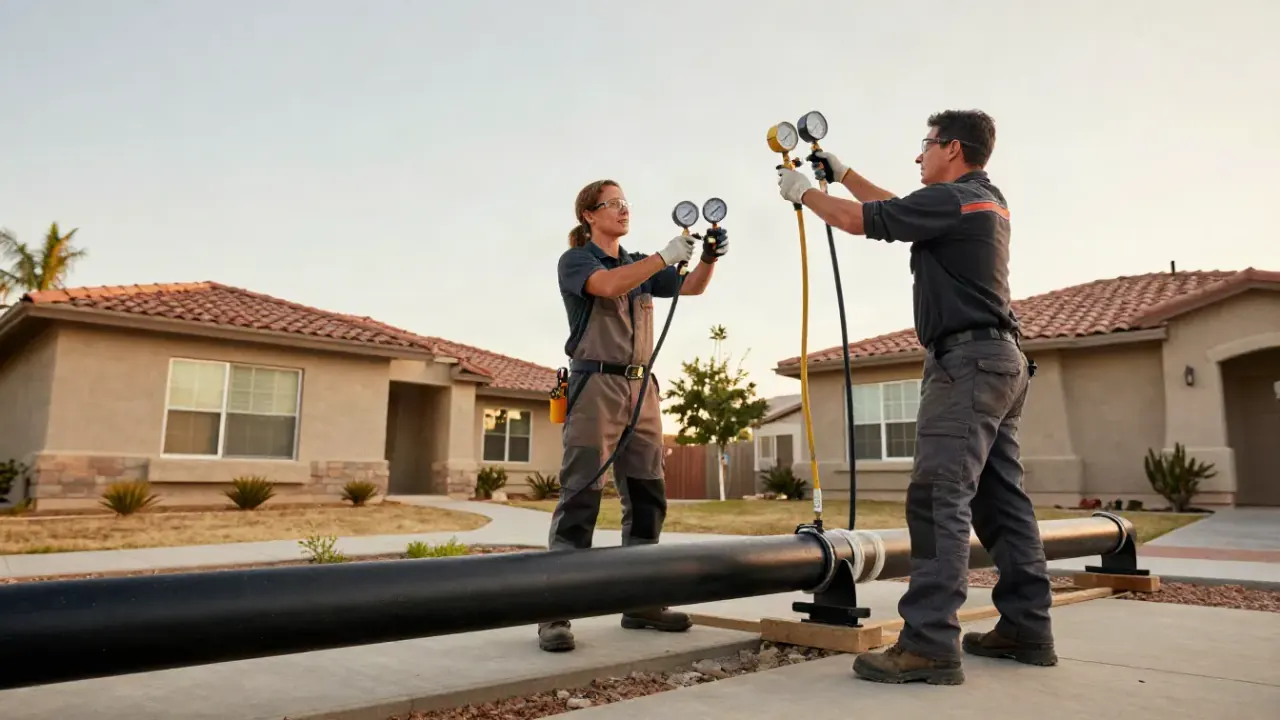
- Pressure-test the line at 10 PSI for 15 minutes minimum.
- Connect the burner, check the flame, and get the inspection signed off.
If your yard already has an outdoor kitchen or BBQ line, we can often tee off it and save 15 to 25 feet of trenching. That is the same approach we use for Gas Line for Outdoor Kitchens and BBQs Fountain Valley CA projects where the pit sits within 20 feet of the grill.
Hard-piped vs flexible connections
Everything underground should be rigid steel or approved polyethylene. Flexible stainless connectors belong only at the final connection to the burner or valve, and only in short lengths. We replace a lot of flex lines that were buried by DIYers - they corrode, kink, and fail pressure tests. If you already have a buried flex line feeding a pit, that is a Flexible Gas Connector Replacement Fountain Valley CA job waiting to happen.
What It Costs to Install a Fire Pit Gas Line in Fountain Valley
Typical 2026 pricing in Fountain Valley for a fire pit gas line runs $850 to $2,400 for a natural gas run, and $400 to $900 for a propane hookup to an existing tank. The spread depends on trench length, soil, and whether the yard has hardscape in the way.
Here is what drives the number:
- Trench length. $18 to $30 per foot for open soil; $40 to $70 per foot under concrete or pavers.
- Permit and inspection. $150 to $350 in Fountain Valley, depending on scope.
- Shut-off valve and riser. $120 to $260 in parts and labor.
- Pressure test. Usually bundled, but $150 to $250 if called out separately.
- Burner and media. Not part of the gas line - expect $400 to $1,500 for the insert, lava rock, or fire glass.
If your meter needs an upgrade to handle the added load, that is a separate gas company job and typically runs $500 to $1,200. We flag that during the site walk so it does not surprise you mid-project.
Do You Need a Permit for a Fire Pit Gas Line in Fountain Valley?
Yes. Any new or extended gas line in Fountain Valley requires a permit from the city's Building and Safety Division, plus a pressure test witnessed by the inspector. There is no exemption for a fire pit, even a small one. The permit is the reason the job takes a week instead of a weekend.
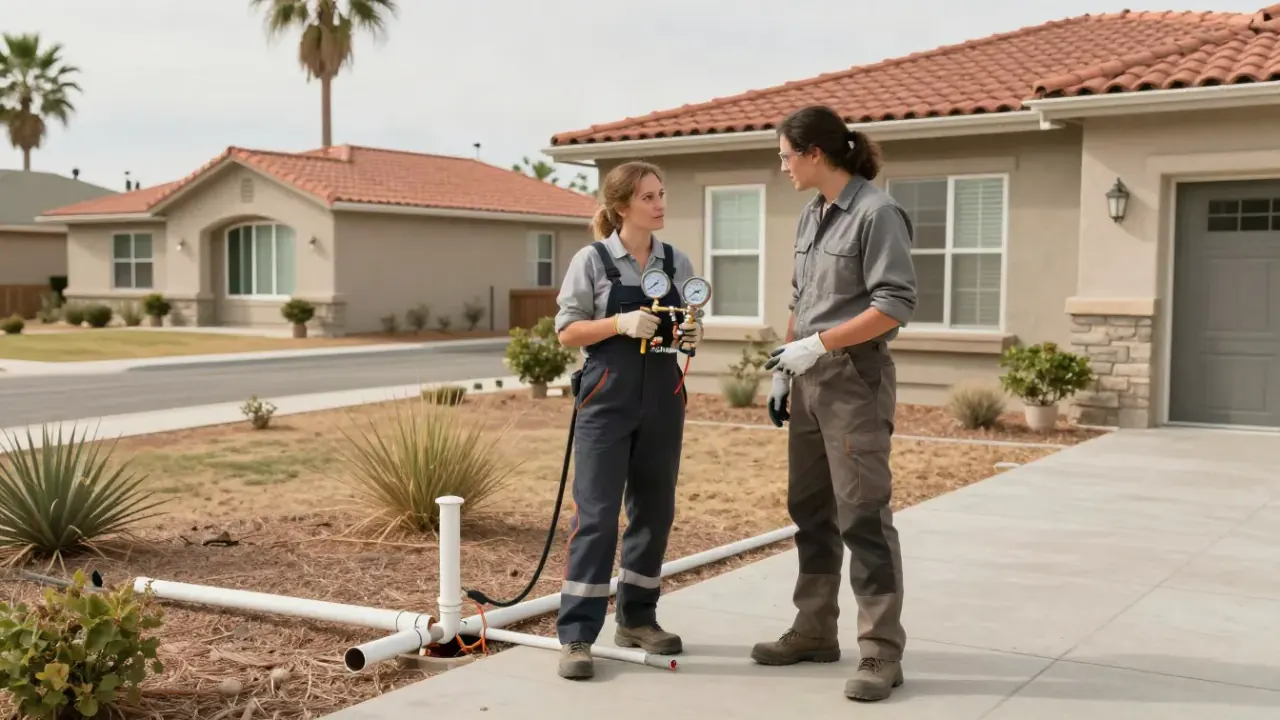
We handle the paperwork, the pressure test, and the inspection walk-through as part of the job. That is exactly what our Gas Line Permit and Inspection Coordination Fountain Valley CA service covers, and it is the piece most homeowners underestimate. Skip the permit and you risk a red tag, a fine, and a line that has to be uncovered for inspection after the fact.
Two more code points worth knowing: the pit needs a manual shut-off valve within sight of the burner, and the line needs to be bonded if it runs within 12 inches of any electrical conduit. Both come up on inspection, and both are cheap to do right the first time.
How Long Does Fire Pit Gas Line Installation Take?
Plan on 4 to 8 hours of on-site work for a straightforward natural gas run, plus 3 to 7 business days for the permit and inspection cycle. Propane hookups to an existing tank usually finish in 2 to 4 hours with no permit delay. The trench itself is the long pole - 40 feet through open soil takes a crew about 90 minutes with a trencher; the same run under a stamped concrete patio can eat a full day.
Weather matters less than you would think. Fountain Valley's dry season from May through October is the easiest window, but we trench year-round. The only real slowdown is when the ground is saturated after a winter storm, which adds a day of dry-out before we can backfill and test.
If your yard has mature tree roots, old irrigation lines, or a pool bond wire in the path, add 2 to 4 hours. We map those before we cut anything.
Common Mistakes We See on DIY Fire Pit Gas Lines
The single most common mistake is burying a flexible connector instead of rigid pipe. It passes a quick bubble test and fails a real pressure test within a year. The second is skipping the 811 call and nicking an irrigation main or, worse, a utility line.
Others we run into:
- No shut-off valve at the pit - code requires one within sight of the burner.
- Undersized pipe. A 60,000 BTU burner needs 1/2-inch pipe up to about 40 feet; beyond that you step up to 3/4-inch or the flame starves.
- Trenching within 12 inches of electrical conduit without bonding.
- Backfilling before the pressure test. Once it is covered, a failed test means digging it up again.
- Using a propane orifice on a natural gas burner. The flame runs yellow and soots the pit.
We see this pattern most often in older pockets of the city - around Downtown Village Gas Line Repair and the 1960s tracts off Talbert, where original yard lines were never mapped and homeowners inherit a mystery pipe from the previous owner.
When to Call a Professional
Call us if you smell gas anywhere near the pit, if the flame burns yellow instead of blue, or if the line was installed before you bought the house and you have no paperwork. Those three situations are the ones that turn into real problems.
We also get called when a homeowner wants to add a second burner, move the pit 10 feet, or tie the fire pit into an existing pool heater line. Those are reroutes, not new installs, and they need a fresh pressure test either way. If you are in one of the newer developments near Fountain Valley Estates Gas Line Repair and your HOA requires a specific pit location, we can plan the route around their rules before you buy the insert.
Our team handles the whole job - permit, trench, pipe, valve, test, inspection. You get a working pit and a signed-off line.
Frequently Asked Questions
How much does a gas line for a fire pit cost in Fountain Valley?
Expect $850 to $2,400 for a natural gas run in 2026, including permit and pressure test. Propane hookups to an existing tank run $400 to $900. Trenching under concrete or pavers adds $40 to $70 per foot.
Can I add a gas line to my backyard fire pit in Fountain Valley CA?
Yes, and most yards here can support it. You need a meter with enough capacity, a trenchable path at least 12 inches deep, and a permit. We check meter capacity during the site walk before quoting.
Do I need a permit for a fire pit gas line in Fountain Valley?
Yes. The city requires a permit and a witnessed pressure test for any new or extended gas line. Budget $150 to $350 for the permit itself, plus the inspection visit. We file and coordinate the whole process.
How long does fire pit gas line installation take in Fountain Valley?
On-site work is 4 to 8 hours for a typical natural gas run. Add 3 to 7 business days for permit and inspection. Propane hookups to an existing tank finish in 2 to 4 hours with no permit wait.
Natural gas vs propane fire pit in Fountain Valley CA - which is better?
Natural gas if you have a meter and can trench - it costs roughly a third as much per hour to run and never needs refilling. Propane if trenching is impractical or you want the pit portable. Both produce the same flame quality.
Get Help with Gas Line Repair in Fountain Valley
Whether you are adding a new pit, replacing a corroded line, or fixing a flame that will not burn clean, we handle it start to finish. Call Fountain Valley Gas Line Repair at (657) 644-0068 and we will schedule a site walk, quote the run, and pull the permit for you.